

How to Check Your Engine Oil: A Simple Step-by-Step Guide
Most of us know we should check our car's engine oil.
The problem is that we're not always entirely sure how to do it, what we're looking for or how often we should be checking it.
As a result, it's one of those jobs that gets put off until a warning light appears on the dashboard.
Unfortunately, by that point, damage may already have been done.
The good news is that checking your oil takes less only a couple of minutes, requires no specialist tools and could potentially save you thousands of pounds in repair costs.
Here's everything you need to know.
Why is engine oil so important?
Think of engine oil as the lifeblood of your engine.
Modern engines contain hundreds of moving metal components operating at extremely high speeds and temperatures. Engine oil lubricates these parts, helping to reduce friction and wear.
It also helps to:
- Keep engine temperatures under control
- Remove contaminants and debris
- Prevent sludge build-up
- Improve efficiency
- Protect against corrosion
Without enough oil, engine components can begin to wear rapidly. In severe cases, low oil levels can lead to catastrophic engine failure.
And that's not a repair bill anyone wants.
How often should you check your oil?
As a general rule, we recommend checking your oil:
- At least once a month
- Before any long journey
- Before towing a caravan or trailer
- If your vehicle is older
- If you've noticed oil spots where you park
Many modern cars will alert you if oil levels become critically low, but relying solely on warning lights isn't a great strategy.
A quick visual check is always better.
Step 1: Park on level ground
Before checking your oil, make sure your car is parked on a flat, level surface.
If the vehicle is on a slope, the oil can collect at one end of the engine, giving you an inaccurate reading.
It sounds like a small detail, but it can make a big difference.
Step 2: Turn off the engine and let it cool
Once you've parked, switch the engine off and wait around 10 minutes.
This gives the oil time to drain back into the oil sump so you get an accurate measurement.
Checking immediately after driving can give a misleading reading because oil is still circulating around the engine.
Step 3: Locate the dipstick
Open the bonnet and look for the engine oil dipstick.
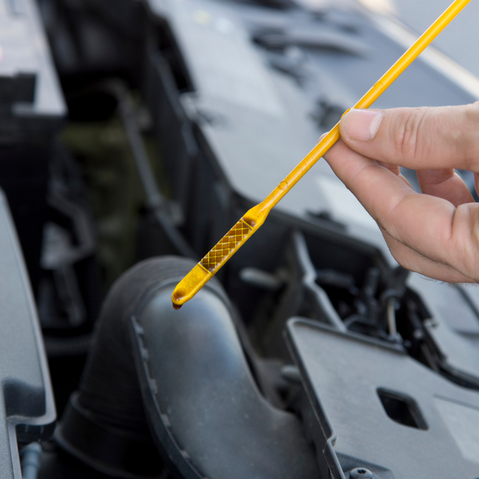
In most cars, it will have a brightly coloured handle, usually yellow, orange or red.
If you're unsure where it is, your vehicle handbook will show you.
Step 4: Remove and Clean the Dipstick
Pull the dipstick out completely.
You'll probably find it covered in oil, which is perfectly normal.
Use a clean cloth or paper towel to wipe the dipstick clean.
Step 5: Reinsert and remove again
Push the clean dipstick fully back into its tube.
Then pull it out again and hold it horizontally.
This second reading is the one you should use.
Step 6: Read the oil level
At the end of the dipstick you'll find markings that indicate the acceptable oil range.
These may appear as:
- MIN and MAX markings
- L and F markings
- Two holes or notches
- A cross-hatched section
Ideally, the oil level should sit somewhere between the minimum and maximum marks.
It doesn't have to be right at the top, but it should comfortably sit within the recommended range.
What if the oil is low?
If the oil level is at or below the minimum mark, you'll need to top it up.
The important thing is to use the correct oil for your vehicle.
Different manufacturers specify different oil grades and specifications, so don't just grab the first bottle you see on a petrol station shelf.
Check:
- Your owner's handbook
- Manufacturer recommendations
- Or ask your local garage for advice
When topping up:
- Remove the oil filler cap.
- Use a funnel if possible.
- Add a small amount at a time.
- Wait a few minutes.
- Recheck the level.
- Take your time.
Overfilling can be just as problematic as running low.
What if there's too much oil?
Many people assume more oil is better.
It isn't.
If the oil level sits above the maximum mark, excessive pressure can build inside the engine, potentially damaging seals and other components.
If you've accidentally overfilled the engine, it's best to get it checked.
Why do cars use oil between services?
A common question we hear is:
"My car's been serviced recently. Why has the oil level dropped?"
The answer is that some oil consumption is completely normal.
Even modern engines can burn small amounts of oil during normal operation.
Factors that can increase oil consumption include:
- High motorway mileage
- Older engines
- Turbocharged engines
- Towing
- Heavy loads
That's why monthly checks remain important, even on newer vehicles.
Don't forget regular servicing
Checking your oil is important, but it doesn't replace routine servicing.
Over time, engine oil becomes contaminated and loses its effectiveness.
Most vehicles require an oil change every 5,000 to 10,000 miles, although this varies between manufacturers and driving styles.
During a service, the old oil is drained and replaced along with the oil filter, helping to keep the engine protected and performing as it should.
Need help? Just ask.
If you're unsure which oil your car needs, can't find the dipstick or would simply prefer somebody to check it for you, we're always happy to help.
At Thame Cars, our workshop team regularly help customers with simple checks and advice, whether that's topping up oil, investigating a leak or carrying out a full service.
We're based in Thame and look after customers from across Oxfordshire, including Haddenham, Chinnor, Long Crendon, Princes Risborough, Wheatley, Bicester and Aylesbury.
Sometimes the simplest jobs are the ones that make the biggest difference.
And spending five minutes checking your oil today could save you a very expensive conversation tomorrow.
📍 Thame Cars, Thame, Oxfordshire
🔧 Servicing, MOTs & Repairs
🚗 Quality Used Cars
🏡 Free collection & delivery available locally
📞 01844 215555
🌐 www.thamecars.co.uk
Safe. Simple. Easy.